
I still cringe thinking about it.
It was a Tuesday morning. 6am Masters session. I was midway through a 400m set when it happened — again. White fog crept across both lenses until I couldn't see the black line. I slowed down, stopped, stood up in the lane, and pulled my goggles off my face.
"Everything okay?" my lane mate called out.
"Yeah. Just my goggles," I said, doing that thing where you spit into the lens and smear it around with your thumb and hope for the best.
It didn't work. Three minutes later, I was squinting through fog again, counting tiles instead of laps, completely out of my rhythm.
I had been swimming Masters for almost four years at that point. And for almost every one of those four years, I had been dealing with the same problem. Foggy goggles. It sounds trivial. It is absolutely not trivial. When you can't see the line, your stroke falls apart, your flip turns become guesswork, and your confidence goes with it.
I had tried literally everything
The lick method. The spit method. The "never touch the inside of the lens" method. Anti-fog sprays from the swim shop. Baby shampoo diluted in water. Special micro-fibre cloths. Keeping them in a case. Not keeping them in a case.
I went through so many pairs of goggles that my husband started raising an eyebrow every time a new box arrived. $30 goggles. $60 goggles. $120 goggles. Different brands, different gasket shapes, different anti-fog coatings. Nothing lasted more than a session or two before the fog crept back.
"It's just what happens with goggles," my coach told me once. "The coating wears off."
I accepted that for way too long.
The morning I nearly gave up
About a year ago, I had what I can only describe as the worst training session of my four years in Masters swimming. Not because of fitness, not because of technique — purely because of my goggles.
We were doing a test set. 10 × 100s on 2 minutes. My goggles fogged up on the third rep. I yanked them up, fixed them, pushed off the wall. Fogged again. By rep six I was essentially swimming blind — doing every alternate length by feel alone, bumping my hand into the lane rope, completely unable to see the wall coming.
I got out at rep seven, sat on the edge of the pool, and thought: is this actually worth it?
I love swimming. I have loved it since I was seven years old. The fact that a $15 piece of silicone could make me consider walking away from something I'd been doing for three decades felt genuinely absurd — but that's where I was.
A conversation in the changing rooms
About two weeks after that session, everything changed. I was complaining (again) to a woman in my squad named Jen. She'd been in Masters for twelve years. Her gear was always sorted, her sessions always looked easy and uninterrupted.
"What goggles do you use?" I asked her.
"NanoClear Strike," she said. "From Effortless Swimming."
I'd heard of Effortless Swimming — it's run by Brenton Ford, a coach based in Australia who has worked with swimmers from absolute beginners all the way up to Olympians. But I'd never looked at their goggles specifically.
"Do they actually not fog?" I asked, probably sounding more desperate than I meant to.
She paused. "I've been using mine for eight months. I think they've fogged maybe twice — and that was my fault for touching the lens."
Eight months. I couldn't remember the last time I'd gone eight sessions without a fog problem.
What I found out — and why it's different
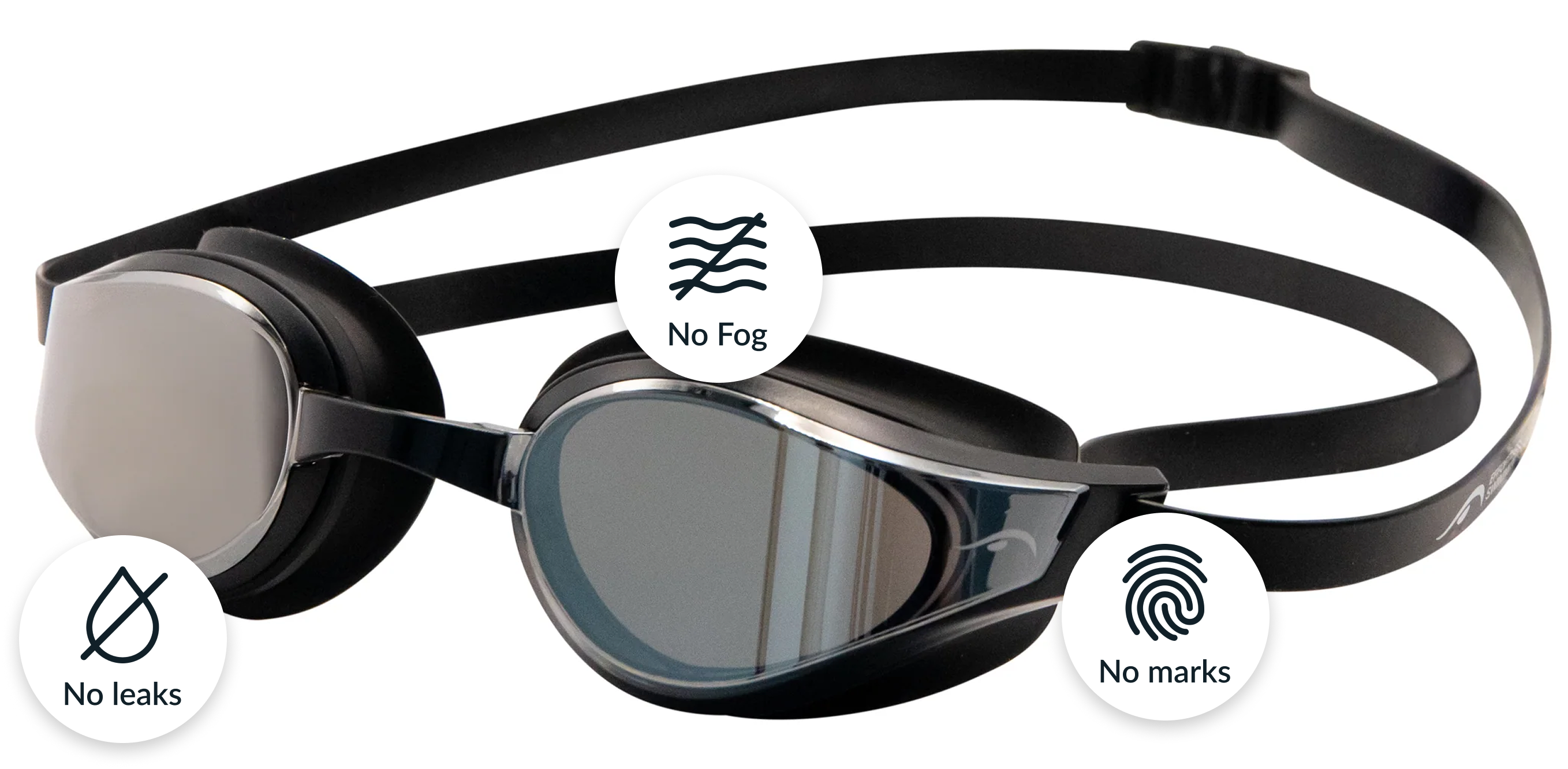
I went home that afternoon and read everything I could find about NanoClear technology. What caught my attention wasn't the marketing — it was the actual explanation of how it works.
Standard anti-fog goggles use a chemical coating on the surface of the lens. This coating absorbs moisture and prevents it from forming droplets (which is what creates the fog effect). The problem is inescapable: the coating is on the surface, so it wears off. It wears off when you touch the lens. When you rinse the goggles. When chlorine gets to work on them. You might get ten good sessions — maybe fifteen if you're careful — before the coating starts to fail.
NanoClear works differently. The nanoparticles are embedded inside the lens material itself — not painted on top. They attract water molecules and spread them into an ultra-thin transparent layer across the lens rather than letting them bead into droplets. Because it's not a surface coating, it doesn't wear away.
- No coating to rub off or wear out with use
- Works session after session without treatment
- No sprays, no spit, no pre-session rituals
- Remains effective in warm indoor and cold outdoor water
I'm not a materials scientist. But this explanation made a kind of logical sense that "just buy better goggles" never had. And I'd spent enough money on goggles at that point that I figured another attempt — at least this one backed by actual technology — was worth the risk.
I ordered a pair of NanoClear Strike goggles in clear lens. (I swim primarily indoors under artificial light, and Jen had said clear gives the best vision without colour distortion in indoor pools.)

My first session — and every session since
I'll be completely honest. I was still bracing for disappointment when I put them on for the first time.
First 200 metres: no fog. I kept waiting for the white creep to start at the edges. It didn't come. I swam my first full kilometre without touching my goggles once.
I don't think I'd done that in years.
By the second session, I'd stopped thinking about my goggles entirely — which, when you think about it, is exactly what should happen. Gear should disappear from your awareness. You should be focused on swimming, not on managing the thing that's supposed to help you see.
What I hadn't expected was what happened to my flip turns. When you can actually see the wall coming, your timing changes. You set up differently. You commit to the turn instead of half-guessing it. Within three weeks my coach had noticed.
"Your turns are much sharper," she said after a session. "Whatever you're doing differently, keep doing it."
I didn't mention it was because I could finally see.
There was also the fit. I'd been swimming in another brand that I'd assumed fitted me well, because I'd always had a red ring around my eyes at the end of sessions and I'd just accepted that as normal. After a few weeks with the Strike, I realised I'd been giving myself a low-grade headache from the suction pressure. The NanoClear Strike uses a flexible gasket that seals without the vacuum effect — by the end of a two-hour session, my face doesn't have that exhausted, bruised feeling anymore.
- NanoClear™ anti-fog embedded in lens — not a coating
- 4 interchangeable nose bridges for a precise fit
- Flexible gasket — seals without suction pressure
- Available in clear, smoke, and mirror lenses
- Used by Olympic-level swimmers
Six months later
I've been using the NanoClear Strike for six months. I swim four sessions a week — two squad sessions, one long aerobic set, one technique clinic. The goggles have fogged in training exactly twice, and both times it was because I touched the lens while adjusting them before a set (user error, as Jen warned me).
Beyond the fog, a few other things have changed that I didn't expect:
My average split times have dropped. I can't attribute all of that to goggles — I've also been working harder on my technique this year — but being able to see the wall, pace my sets properly, and swim without constant interruptions has made a measurable difference.
I actually look forward to long sets now. There's something you don't realise until it's gone: how much mental energy you spend managing a gear problem. Knowing I can get in the water and just swim — without doing a fog check every 200m — has made training feel lighter.
I stopped impulse-buying goggles. This sounds small but it adds up. In the three years before finding the Strike, I estimate I spent close to $400 on goggles that either fogged, leaked, or gave me a headache. My current pair has outlasted all of them combined.
Who should consider these
I'm not here to hard-sell anyone. If you're happy with your current goggles, there's no reason to change.
But if you recognise any of the following, it might be worth looking at the NanoClear Strike:
You've tried multiple anti-fog solutions and the problem keeps coming back. Your sessions are regularly interrupted by fog stops. You get a headache or pressure marks around your eyes after longer sets. You swim in a warm indoor pool where fogging is worst (the temperature difference between water and air is one of the main fog triggers).
The thing I wish someone had told me is this: the problem usually isn't technique or care or the spray you're using. The problem is the technology underneath. Surface coatings will always wear off. If you want something permanent, you need something that doesn't rely on a surface.


